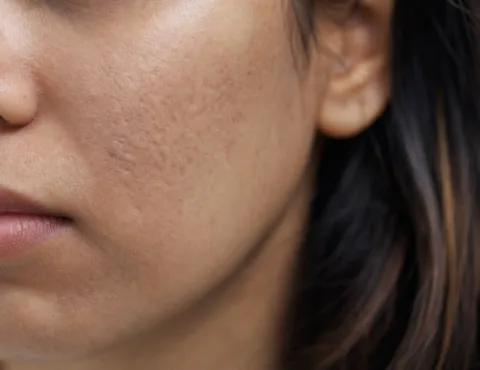
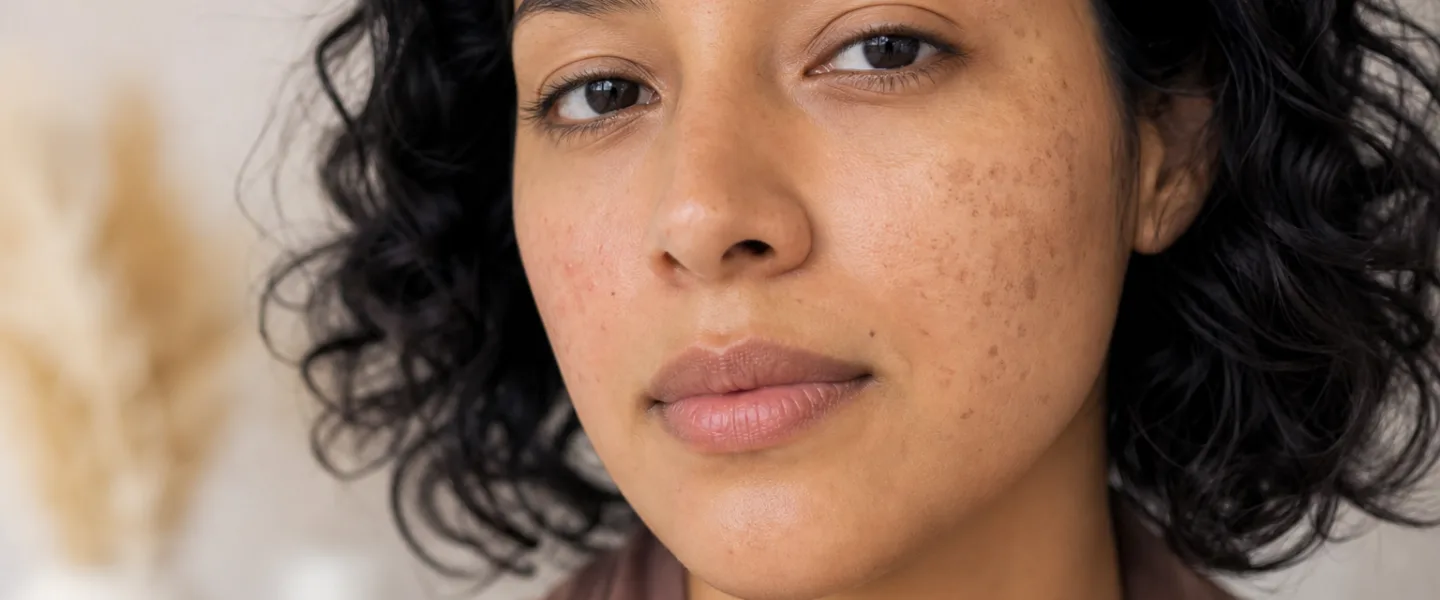
Post-acne redness vs. dark marks begins with a practical distinction: PIE is the red post-acne pattern, while PIH appears brown to grey-brown. That difference helps focus the treatment conversation on redness, pigmentation, or a combination of both. PIE and PIH can appear together, so one area of post-acne discoloration may involve more than one concern.
At AcneClinicNYC, we use our Skin Health & Rejuvenation Assessment — In-Clinic to evaluate PIE and pigmentation alongside rosacea, melasma, and signs of aging, then provide a personalized treatment and home-care plan.
PIE vs. PIH: start with the color of the post-acne mark
Post-inflammatory erythema, or PIE, is the red component that can remain after inflammatory acne has cleared. A retrospective study of acne-induced post-inflammatory changes describes PIE as telangiectasia and erythematous papules. The same study notes that these vascular lesions are close to the skin surface and appear red.
Post-inflammatory hyperpigmentation, or PIH, is the darker-color pattern. In that study, acne-related PIH appeared as localized or diffuse brown-to-grey-brown macules at acne-lesion sites and became most apparent after PIE had resolved.
Color provides a useful starting point rather than a complete treatment plan. Predominantly red marks bring redness and erythema into focus; predominantly brown or grey-brown marks bring pigmentation into focus. The distinction helps make the next conversation more precise.
Why post-acne redness and dark marks can overlap
PIE and PIH often present together. A post-acne area can have both a visible red element and a brown-to-grey-brown element, rather than fitting neatly into one category. This overlap is why broad advice for “acne marks” may not address the specific concern that is most visible.
Persistent redness also calls for realistic expectations. The retrospective study reports that facial PIE improves very slowly with time and, in some cases, is never completely cleared. Its visible color does not establish a fixed timeline or determine one treatment choice for every person.
In our in-clinic assessment, we distinguish PIE and pigmentation concerns, consider active acne and treatment history, and connect those findings to a personalized treatment and home-care plan. That creates a practical bridge between what you see and the type of discussion that follows.
How PIE and PIH change the treatment conversation
For redness, pigmentation, acne, and post-acne discoloration, we use BBL Therapy, a broadband-light treatment that may involve little to no downtime. Its verified scope makes it relevant when the conversation includes red marks, dark marks, or both.
When red and dark post-acne marks appear together, AcneClinicNYC identifies Laser Genesis and BBL as options that can address that combination. This keeps the focus on the mixed pattern rather than treating red and brown color changes as automatically identical concerns.
When pigmentation is the main focus, Cosmelan is an in-clinic and home-maintenance depigmentation program used for melasma and post-inflammatory hyperpigmentation. Customized Chemical Peels are selected according to acne, pigmentation, sensitivity, and recovery preferences. These are pigment-focused options to discuss when brown-to-grey-brown marks are the dominant visible concern.
The practical comparison is straightforward: BBL has verified use across redness, erythema, pigmentation, acne, and post-acne discoloration; Laser Genesis and BBL can be considered for mixed red-and-dark marks; and Cosmelan or a customized peel brings the discussion toward pigmentation. Selection follows the concerns identified in your assessment.
When an in-clinic assessment is the useful next step
Persistent marks, overlapping red and dark color, ongoing acne, and a history of prior treatments are all useful details to bring into the conversation. Skin Health & Rejuvenation Assessment — In-Clinic evaluates PIE, pigmentation, rosacea, melasma, and signs of aging, with a personalized treatment and home-care plan.
Book your Skin Health & Rejuvenation Assessment — In-Clinic at AcneClinicNYC for a plan centered on redness, pigmentation, or the combination visible after acne.